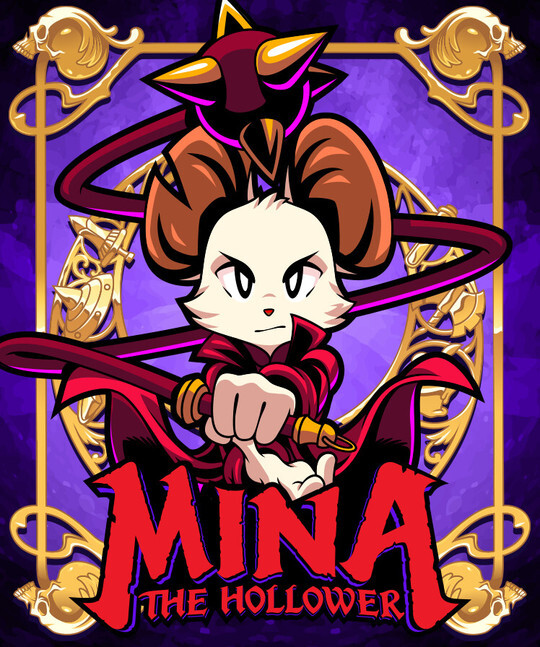
Mina the Hollower is a 2D action-adventure game where you play as Mina, a mouse who can “hollow” or tunnel underground. The game is set on Tenebrous Isle, and Mina has been summoned by the philanthropist Lionel (a lion) to repair the Spark Generators that power the island. As her ship arrives, it is attacked by a huge sea monster, and it soon becomes clear that the whole island is overrun with monsters.
At the beginning of the game you choose one of three weapons to be your main. I chose the Nightstar, a mace, because it provided a bit more range than some of the others. Two other weapons are obtainable later in the game, for a total of five. While exploring, you will also discover various Sidearms, or secondary weapons. Most commonly, I used the Volt Hatchet or Gyro Dagger, but many others were available including a Fishing Rod, the Iron Steed (bike), and the Deflector Parasol (umbrella). Unlike your main weapon, sidearms expend Joules (energy) with each use, so you can’t just spam them. Additionally, you can discover and equip many Trinkets that have a variety of effects, including raising your attack level, making you completely invulnerable when you stay still, or letting you hollow (burrow) for longer, to name just a few. Initially you can only equip one trinket at a time, but that is upgraded as the game progresses, and it becomes possible to adjust your trinket loadout for different bosses or scenarios.
It’s a good thing the weapons, sidearms, and trinkets provide for deep customization, because combat in Mina the Hollower can be pretty unforgiving, especially at first. When I started playing, even the weakest enemies were giving me fits. It’s the sort of game that punishes you until you realize you need to be careful about taking any damage. To heal, you need to use one of your two Plasma vials, but the extent of the healing effect depends upon you dealing damage (which fills the vial) and not taking damage (which depletes it) — a mechanic I found quite aggravating. In the beginning, you are lucky if you are able to heal at all, because many enemies can one-shot you. When you die, you lose one Spark, and initially you only have one. If you die without a spark, known as a Sparkless Demise, you lose your Bones (money) and return to your last save point. That Souls-like mechanic of losing your money when you die makes the early hours of the game kind of a slog. I found myself grinding through the same basic enemies over and over to save up enough Bones to buy upgrades (Attack, Defense, and Sidearm strength) and useful trinkets.
It probably took me longer than it should have to upgrade my character enough to feel safe exploring further afield, where the enemies are even stronger. But it’s fair to say I was not having much fun for the first, say, 4 hours. Eventually, though, I was plowing through enemies easily, able to afford taking some damage to dispatch them quicker. Toward the end of the game, my build was powerful enough that I was beating bosses on the first or second try. That is, until I encountered the penultimate boss, who was much, much more difficult. That difficulty spike caught me out. I’m pretty persistent as a rule, and I was heavily motivated to beat this game, but after trying the same boss fight like 30+ times, tweaking my build over and over again to no avail, well… I just kind of lost interest. My backlog is long, and life is too short to stay stuck on any one game. I had to move on.
The eight-bit art of Mina the Hollower is beautiful in its way. The chiptune music is outstanding and regularly got stuck in my head. The story was quite interesting while staying out of the way. After the initial hours, and before the aforementioned difficulty spike, the game was quite fun. I’m sure it will be atop many Game of the Year lists. And while I don’t deny that Mina the Hollower was exceptional in many ways and deserves all the accolades it will no doubt receive, I have to admit it was just not quite my cup of tea. Oh well! On to the next one.